
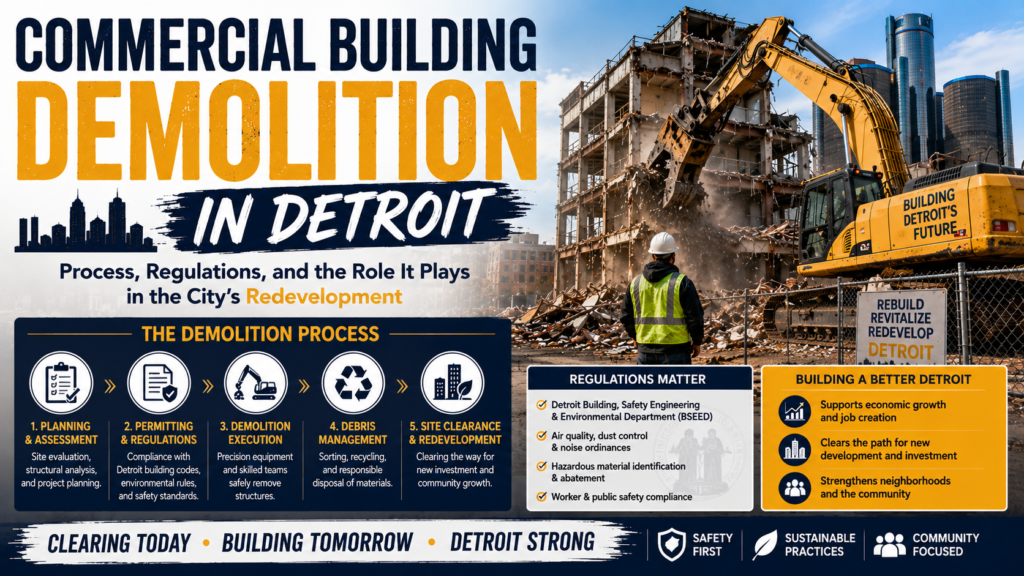
Detroit is a city in active transformation. Across its commercial corridors and industrial zones, buildings that once housed factories, retail stores, offices, and warehouses are being evaluated, redeveloped, or removed to make way for new uses. Commercial Building Demolition Detroit is a central part of this process. It is considerably more complex than residential demolition, involving larger structures, more stringent regulatory oversight, greater environmental risk management requirements, and a higher degree of technical expertise at every stage. Understanding how commercial building demolition works in Detroit, and what makes it distinct, is essential knowledge for developers, property owners, and commercial real estate stakeholders in the city.
What Defines Commercial Building Demolition
Commercial building demolition encompasses the removal of structures built for non-residential purposes, including retail buildings, office complexes, warehouses, industrial facilities, schools, hospitals, hotels, and mixed-use structures. These buildings are typically larger, more structurally complex, and built with a wider range of materials than residential structures. Many of Detroit’s commercial buildings also reflect decades or even a century of use, renovation, and adaptation, adding additional complexity to planning and execution.
Planning and Site Assessment for Commercial Demolition
Successful commercial building demolition begins long before any equipment arrives on site. The planning phase is extensive and involves multiple types of professional assessment.
Structural and Engineering Survey
A licensed structural engineer conducts a comprehensive assessment of the building, evaluating its construction type, materials, structural system, condition, and any complications such as prestressed concrete, high reinforcement density, or unusual structural configurations. The engineering survey identifies how the building needs to be approached during demolition to prevent uncontrolled failure and protect neighboring properties. In Detroit’s dense commercial districts, this analysis is particularly critical where buildings share walls or are in close proximity to occupied structures.
Hazardous Materials Survey
Older commercial buildings in Detroit are highly likely to contain asbestos, lead-based paint, polychlorinated biphenyls (PCBs) in electrical equipment and caulking, mercury in fluorescent lighting and thermostats, and potentially underground storage tanks. A comprehensive hazardous materials survey by certified inspectors is required before demolition permits can be issued. The scope and methods of hazardous material abatement are specified in the permit application and must be completed by licensed abatement contractors before demolition of the main structure proceeds.
Utility Disconnection and Decommissioning
Commercial buildings typically have more complex utility infrastructure than residential properties, including high-voltage electrical service, natural gas, water, sewer, telecommunications, fire suppression systems, and elevator systems. All of these must be formally decommissioned and disconnected in coordination with the relevant utility providers and service companies before demolition begins. Failure to properly decommission utilities creates serious safety risks during demolition.
Demolition Methods for Commercial Structures in Detroit
The method or combination of methods used for commercial demolition depends on the size, construction type, location, and surrounding conditions of the project.
Mechanical Demolition with Excavators
For low-to-mid-rise commercial structures, mechanical demolition using large hydraulic excavators equipped with demolition-specific attachments is the most common approach. Long-reach excavators can work from outside a building’s perimeter, reducing risk to operators. Different attachments serve different functions: hydraulic breakers for concrete, shears for steel framing and structural members, pulverizers for crushing concrete and separating reinforcement. The mechanical method is highly efficient for single-use commercial structures such as retail boxes, warehouses, and industrial buildings.
Selective and Interior Demolition
For commercial projects where portions of a building are being retained, or where a building is undergoing adaptive reuse, interior demolition removes specific elements while preserving the primary structural shell. This is common in Detroit’s older commercial and industrial buildings that are being converted to loft apartments, event spaces, breweries, or other new uses. Interior demolition strips buildings back to their structural core, removing outdated finishes, mechanical systems, partitions, and hazardous materials while preserving the architectural bones that give historic Detroit buildings their character.
Implosion for Large Structures
For very large commercial or industrial structures where mechanical demolition would be prohibitively time-consuming, or where site access limitations make top-down mechanical methods impractical, controlled implosion using precisely placed explosive charges offers an efficient alternative. Detroit has seen this method applied to major structures, and it remains a viable option for large commercial demolition projects in appropriate locations with sufficient safety perimeters.
Regulatory Requirements for Commercial Demolition in Detroit
Commercial demolition in Detroit is subject to a layered regulatory framework involving city, state, and federal requirements.
The City of Detroit BSEED requires demolition permits for all commercial structures. For larger projects, the submission must include engineering drawings, a hazardous materials abatement plan, a demolition methodology plan, and in some cases a geotechnical report. Permits are reviewed for compliance with the Michigan Building Code, Detroit zoning requirements, and city-specific regulations. On-site inspections are conducted at various stages of the project.
At the state level, the Michigan Department of Environment, Great Lakes, and Energy oversees asbestos abatement notification and compliance. Federal OSHA requirements govern worker safety standards on demolition sites, including fall protection, equipment operation, and hazardous material handling.
Wayne County also has jurisdiction over soil erosion and sedimentation control permits for projects that disturb significant areas of land, which is relevant for large commercial demolition sites where significant grading and site preparation follow the structure removal.
Waste Management and Material Recycling
Commercial buildings produce substantially more demolition waste than residential structures, and the management of that waste is a significant part of the project. Responsible commercial demolition involves sorting materials at the site or at processing facilities to maximize recycling and minimize landfill disposal. Concrete is recycled as aggregate base material for road construction and new building foundations. Structural steel is a highly recyclable commodity with established markets. Aluminum, copper, and other non-ferrous metals are sorted and sold as scrap. Clean wood framing can be chipped for biomass fuel or composted.
For projects seeking LEED certification or compliance with sustainable building standards, detailed waste diversion documentation is required, tracking the volume and type of materials diverted from landfill. Detroit’s own Recycle Ann Arbor Recovery Yard and similar facilities in the region provide construction and demolition recycling services to contractors across Southeast Michigan.
Commercial Demolition and Detroit’s Redevelopment Story
Detroit’s commercial demolition activity is inseparable from the city’s ongoing revitalization narrative. The removal of obsolete or dangerous commercial structures across neighborhoods from Midtown to the west side and beyond has opened land for new investment, allowed developers to assemble parcels for larger mixed-use projects, and removed blight that was dragging down surrounding property values and community confidence.
The city has worked to invoice private owners who allowed commercial properties to deteriorate to the point of requiring city-ordered demolition, recovering demolition costs through enforcement mechanisms. This approach signals a shift toward greater accountability for commercial property owners and reflects the city’s commitment to ensuring that the costs of blight are not borne entirely by the public.
For developers and investors in Detroit’s commercial real estate market, understanding the demolition process, its timeline, regulatory requirements, and what it takes to prepare a cleared site for new construction, is a foundational part of any project that starts with an existing structure.